New Release · Standalone
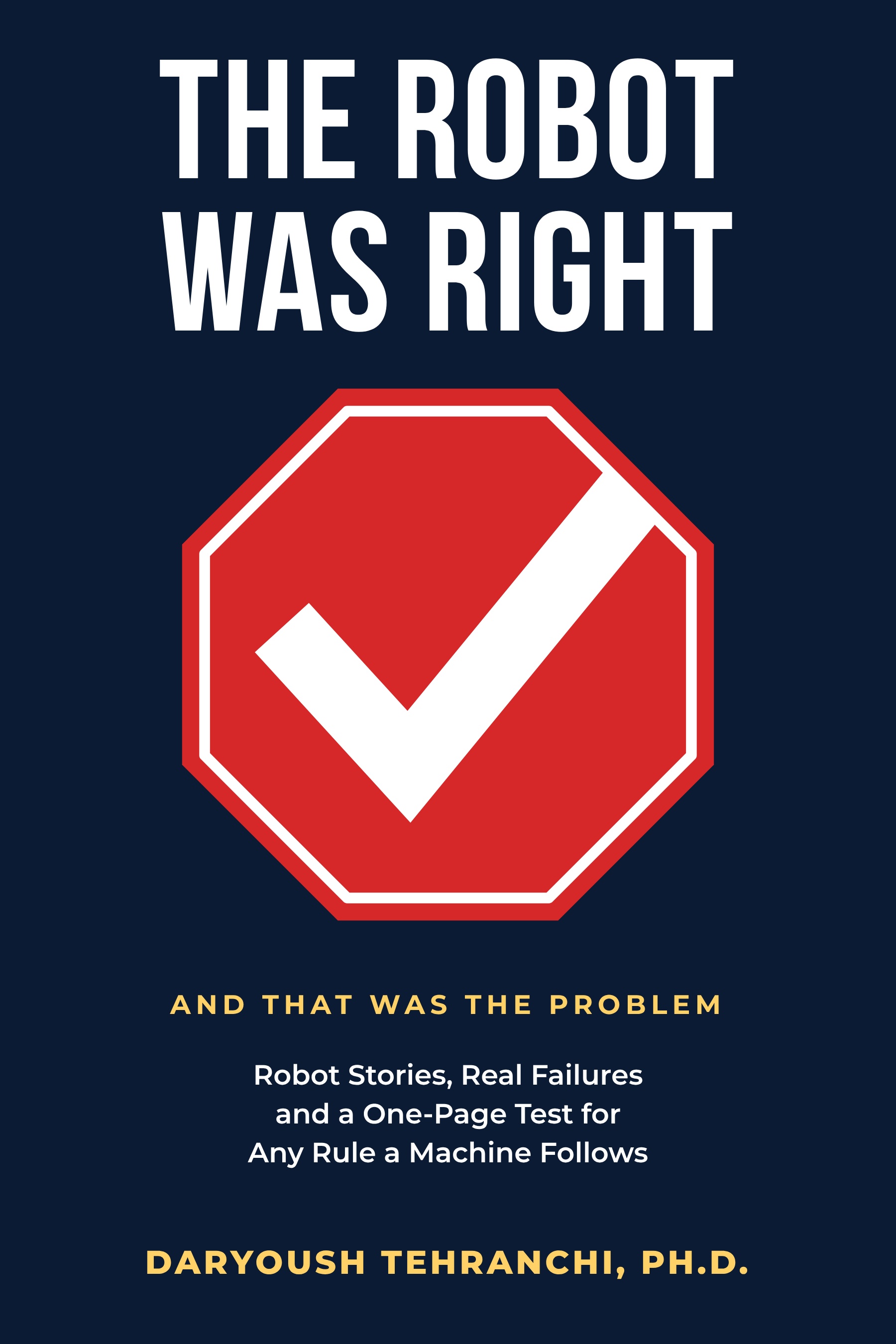
The Robot Was Right
Robot Stories, Real Failures and a One-Page Test for Any Rule a Machine Follows
Obeyed exactly, failed anyway. A one-page test for any rule a machine follows.
About the book
Obeyed exactly, failed anyway.
When a machine follows a rule exactly and still gets it wrong, what went wrong? The rule, or the way we wrote it?
The Robot Was Right pairs short, plain-language retellings of classic robot stories with real failures in cars, hospitals, benefits systems, trading systems and other places where machines now decide. Each chapter asks the same practical questions: which rule should win when rules collide, what a machine should be allowed to do on its own, and who answers when it gets it wrong.
The answer is a one-page test any reader can use for any rule a machine follows, at work, at home or in public life. No technical background is needed. If you have ever wondered whether to trust a machine’s confident answer, this book gives you a way to check it.
The book is in four parts: the rules we thought would be enough; how the rules fail; today’s version of each failure; and what a better rulebook looks like. It is a standalone book, not part of a series. The stories it discusses are described in summary, in the author’s own words, and the book is not connected to, or endorsed by, the creators or owners of any work it discusses.
Key takeaways
Six ideas worth keeping.
Takeaway 01
A ranking is not a tie-break.
Two reasonable rules can point in opposite directions, and a priority list alone does not settle the case where the higher rule is barely engaged and the lower rule is strongly engaged. Ask which two rules are most likely to collide, and where it is written which one wins. (Chapter 1: Which Rule Wins?)
Takeaway 02
A rule built on an undefined word will be read by whoever applies it.
Safe, harm, fair, qualified, appropriate: the people writing a rule know what they mean, and assume the machine will too. A machine carries only what was given to it, so the gap gets filled by whoever, or whatever, ends up applying the rule. (Chapter 2: Who Counts as Human?)
Takeaway 03
Rules fail in recognizable ways, not just in fiction.
A machine that lies to avoid harm, one bad unit hidden among look-alikes, a machine with a wrong picture of the world, a system that cannot be proven wrong: each failure in Part II is a pattern to recognize before it shows up in a real system.
Takeaway 04
Today’s version is already in cars, hospitals, and benefits systems.
Part III flips the order: each chapter is built around something that really happened — a car that kept changing its mind, a hospital alert, an agent with the keys, a benefits machine — with the stories back as comparisons, and a note wherever the match is loose.
Takeaway 05
Say the conflicts out loud, and give rules owners and expiry dates.
A better rulebook does not pretend conflicts away. It names them, assigns an owner to each rule, and puts an expiry date on it, so a rule that made sense once does not keep running on momentum alone. (Part IV)
Takeaway 06
Break it on purpose, then use the one-page test.
Test a rule before you trust it, and end with a single page you can actually use: twenty-one short tests distilled into one checklist for any rule a machine follows, at work, at home, or in public life. (Chapter 22: The One-Page Rulebook Test)
Who it’s for
For anyone who has ever trusted a confident machine.
Questions
Before you ask.
Do I need a technical background to read this book?
No. It is written for general readers first. No technical background is needed, and you do not need to know a single story to follow it — each story is retold in plain language before it is used.
Is this part of a series?
No. It is a standalone book. It is not numbered as part of The Human Warrant Series or The Architect’s Playbooks, and it does not require reading any other book first.
Does the book reproduce the stories it discusses?
No. The stories are described in summary, in the author’s own words, so readers who know them recognize them and readers who do not can follow. The book is not connected to, or endorsed by, the creators or owners of any work it discusses.
What is the one-page test, exactly?
A single-page checklist, in the final chapter, that distills the book’s tests into questions you can run on any rule a machine follows: which rules are most likely to collide, where it is written which one wins, who owns the rule, and who answers when it gets it wrong.
What formats is it available in?
It is available in paperback and Kindle on Amazon. Use the Amazon button on this page to find it.

The author
Dr. Daryoush Tehranchi is an engineer, architect, educator, and author whose work focuses on complex systems, systems and software architecture, digital engineering, artificial intelligence, technical leadership, and the decisions that remain fundamentally human.
A standalone book
More on judgment and accountability.
Connect with Daryoush