Book 1 of The Architect’s Playbooks
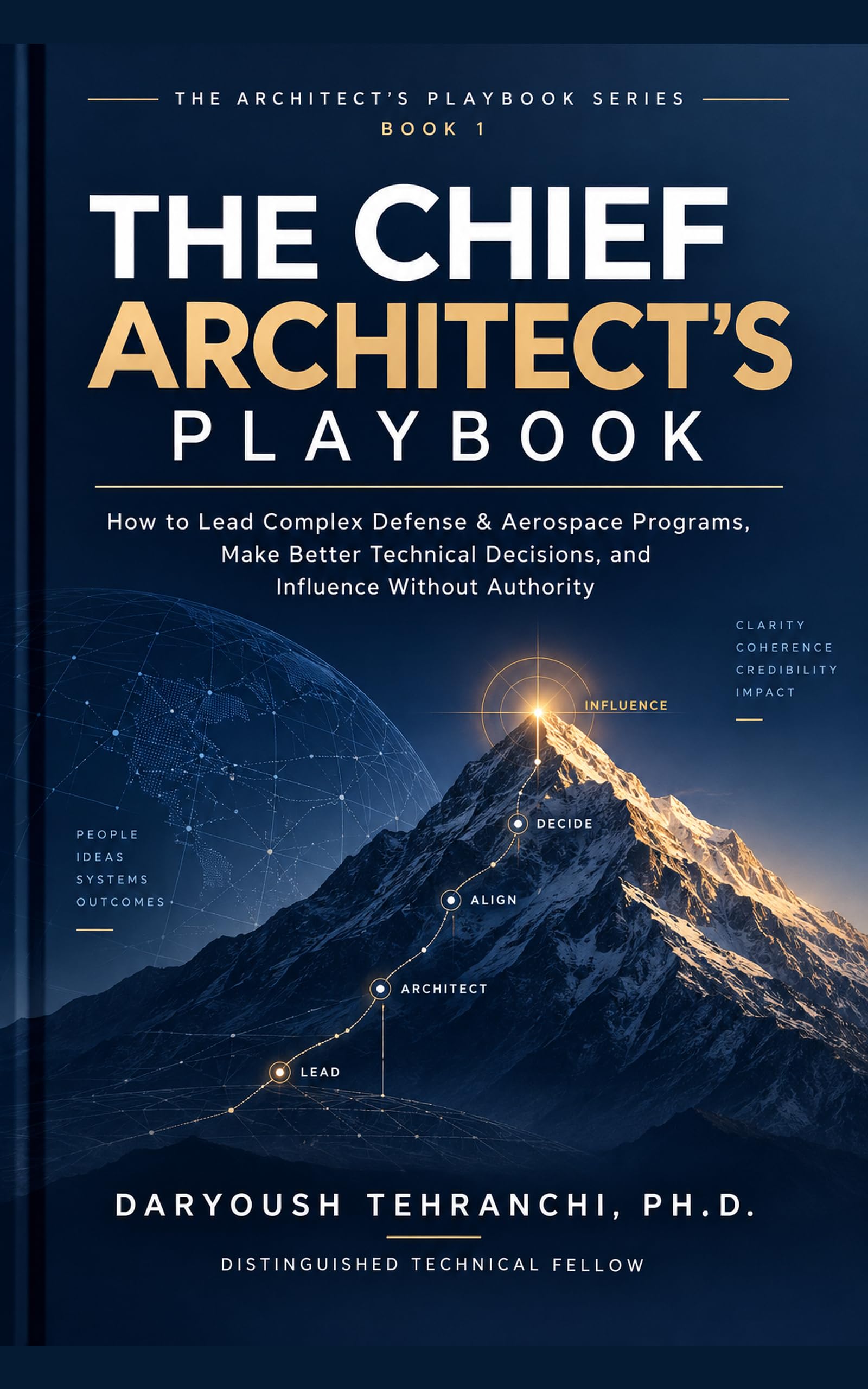
The Chief Architect’s Playbook
How to Lead Complex Defense & Aerospace Programs, Make Better Technical Decisions, and Influence Without Authority
Technical leadership for defense and aerospace: earn credibility, decide under uncertainty, and influence without authority.
About the book
The job nobody trains you for.
Most engineers get promoted into senior technical roles for being right about the engineering. Then they discover, usually within months, that the new job runs on something nobody trained them for: getting a room full of talented, opinionated people to build something coherent — almost always with less formal authority over them than the job seems to require.
The Chief Architect’s Playbook is written for exactly that moment. Drawing on four decades of mission-critical defense, space, and intelligence work — including the U.S. Air Force, national labs and primes, and Fortune 500 defense companies — Dr. Daryoush Tehranchi distills what the role of chief architect actually is, underneath the org chart: owning the architecture of something too large for any one person to build alone, and earning the trust that makes people route their hard problems to you before there’s a crisis. This is the leadership book for the world commercial tech books don’t describe — classification boundaries, government funding cycles, mission stakes that don’t forgive “fail fast.” Each chapter is grounded in anonymized case studies, described by scale and domain, and reads less like a war story than a worked example you can hold up against your own situation.
The book shows how to:
- Earn credibility the slow way — through verifiable reasoning, consistency, and owning mistakes before someone else raises them
- Draw the architecture–design boundary and defend its narrowness: if a team can change it without affecting anything outside its scope, it’s design, and it’s theirs
- Make defensible commitments under uncertainty, moving fast on reversible decisions and slowing down, documenting, and building an escape hatch on irreversible ones
- Move engineering teams with no authority over them — relationships built before the ask, certainty separated from open questions, success criteria set by the other side
- Disagree with a project lead without damaging the relationship, and escalate in a way that’s never a surprise
- Brief executives in the time they actually have: the decision, the confidence behind it, the cost of being wrong
- Stop analysis when it stops changing the decision, instead of boiling the ocean
- Take on technical debt deliberately, with a funded payoff plan — and spot the kind that quietly becomes a crisis
- Hand real responsibility to the next generation of engineers instead of just handing them tasks
It closes with The Architect’s 20 Rules — a short list written for a hard day, when there isn’t time to reread a whole chapter to remember what actually matters.
Key takeaways
Six ideas worth keeping.
Takeaway 01
Credibility is a currency you earn slowly and spend quickly.
It compounds decision by documented decision, not by title. The habits that build it: being right in ways others can verify (“check my work,” not “trust me”), giving the same category of problem the same quality of answer every time, and owning a mistake out loud before anyone else has to raise it. The real signal isn’t on the org chart — it’s when engineers, program managers, and customers start routing hard problems to you before they become crises. (Chapter 2)
Takeaway 02
Architecture is what must be decided once, centrally.
The operational test for what belongs at the architecture level: could the team change this without affecting anything outside its boundary? If the answer is yes, it’s design, and it’s theirs. Over-specification isn’t thoroughness; it’s a tax on every downstream team, and it quietly removes ownership from the people actually building the system. (Chapter 3)
Takeaway 03
Move fast on reversible decisions; slow down on irreversible ones.
Waiting for perfect information doesn’t get you certainty — it just moves your decision later, onto a more compressed schedule, with less room to course-correct. Make the risk explicit in writing: what you know, what you’re betting on, and what would have to change for you to revisit the call. A well-reasoned bet, presented honestly as a bet, builds more credibility than false certainty that later turns out to be guesswork. (Chapter 4)
Takeaway 04
Influence without authority produces buy-in that authority often can’t.
The relationships that make it possible get built long before you need anything from anyone. In the room, separate what you’re certain about from what you’re proposing as open to revision, find the version of the technical solution that serves both teams’ objectives instead of negotiating a compromise, and let the other side define what “working” means so the result can’t be second-guessed later. (Chapters 5 and 11)
Takeaway 05
Briefing an executive is translation, not simplification.
They don’t need the architecture explained to them; they need the decision on the table, the recommendation, the confidence behind it, the cost of being wrong, and what would flip the recommendation. Build the briefing backward from the decision, keep a deeper layer in reserve for whoever asks, and name the defense-specific constraints honestly instead of designing around them at the last minute. (Chapter 7)
Takeaway 06
Stop analysis when it stops changing the decision.
Over-architecture usually comes from thoroughness that feels like professionalism, past the point it adds value — and it looks like diligence from the outside. Before commissioning more work, ask what specific decision it would change; rank decisions by blast radius and reversibility and give the deep review only to the ones that score high on both. (Chapter 8)
Who it’s for
For the engineer who just got promoted past their training.
Questions
Fair questions.
I’ve just been promoted to chief architect and nobody explained the job. Is this book for me?
Yes — that’s close to the book’s primary reader. The first two chapters lay out what the role actually is and how the credibility it runs on gets built, before the later chapters cover decisions under uncertainty, influence without authority, and executive communication. Read it straight through or use it as a reference for the specific problem in front of you.
Most leadership books are written for Silicon Valley product teams. Is this another one?
No. It’s written for defense, aerospace, and national security programs — classification boundaries, acquisition and funding cycles that move on government time, mission stakes that don’t forgive “fail fast,” and customers who are, quite literally, the government. Every example comes from that world.
I have direct reports. Is this still relevant?
Both. The core is technical leadership that runs on credibility instead of org-chart authority, but Chapters 10 and 12 go directly at people-leadership: why brilliant engineers fail as leaders, and how to mentor by handing junior engineers decisions with real, survivable consequences.
Does the book cover AI?
Chapter 13 takes it on directly: the durable case is speed and coverage — AI as a fast first draft for analysis, documentation, and trade studies — while the risk to guard is mistaking fluent, well-organized output for correctness. Treat AI-generated technical content like a draft from a capable but unsupervised junior engineer.
Is this a memoir?
No. Examples are described by scale and domain rather than program name — partly because much of the work was on classified or sensitive programs, and partly because the lessons generalize better without the specifics. Each chapter carries at least one anonymized case study written as a worked example, not a war story.

The author
Dr. Daryoush Tehranchi is an engineer, architect, educator, and author whose work focuses on complex systems, systems and software architecture, digital engineering, artificial intelligence, technical leadership, and the decisions that remain fundamentally human.
The Architect’s Playbooks
More from the series.
Connect with Daryoush