The Human Warrant Series
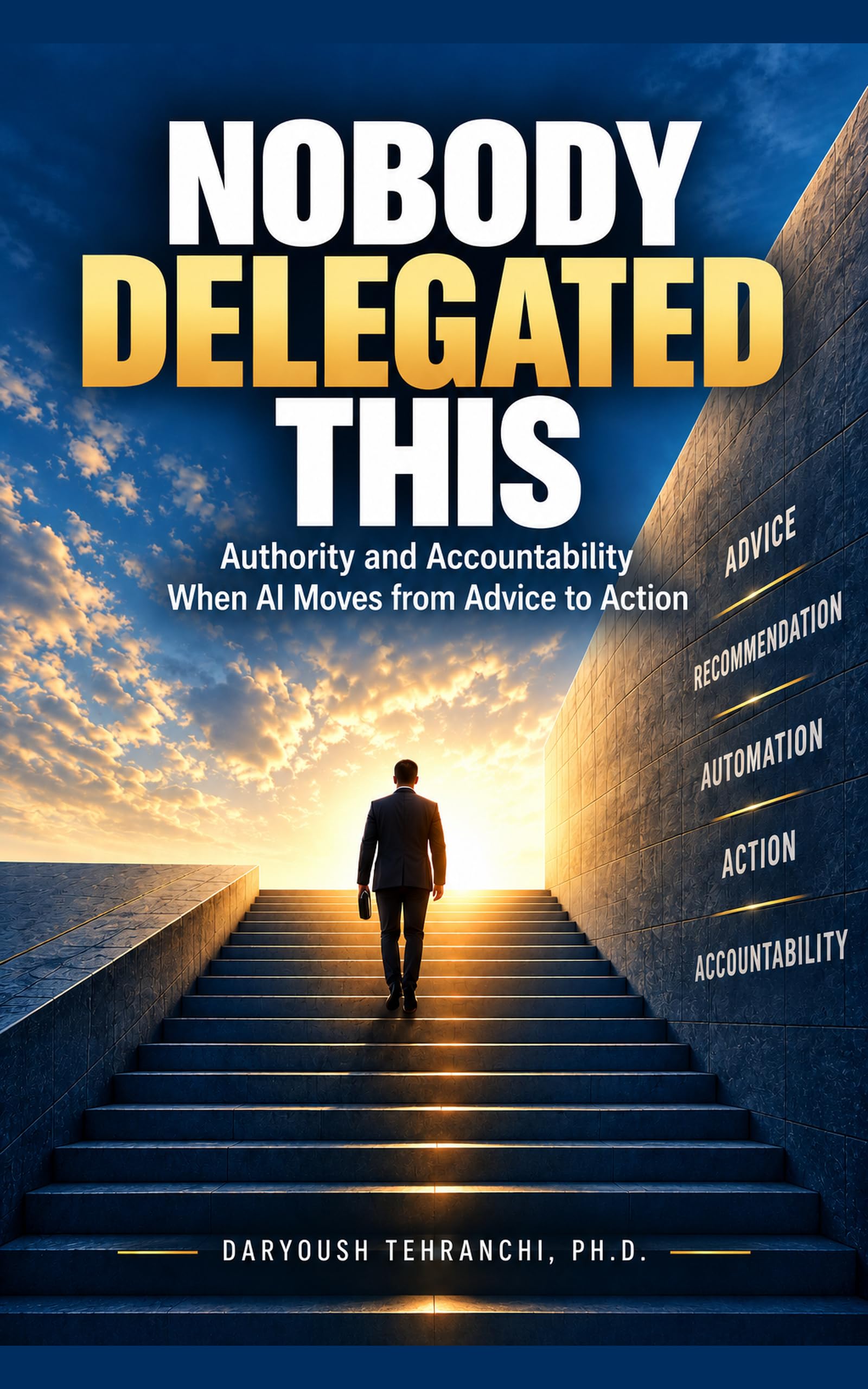
Nobody Delegated This
How Authority and Accountability Shift When AI Moves from Advice to Action
When AI moves from advice to action, who actually decides — and who answers for it? A practical guide to the authority gap.
About the book
The authority gap nobody voted on.
When something goes wrong now, there is a new beat in the meeting before the old questions — a beat that didn’t used to exist: whose model recommended this, who approved it, and how closely did anyone actually check?
Nobody Delegated This is about what happens when AI moves from advice to action inside organizations: the quiet, step-by-step migration of authority that nobody ever voted on, and the gap it opens between who holds a title and who — or what — actually decides. Drawing on four decades of leading complex technical programs and chairing review boards, Dr. Daryoush Tehranchi argues that this gap is structural, not personal — and that structural gaps have structural fixes.
This is a practical book, not a meditation. You’ll get an eight-position map for finding where decision authority really sits, a four-tier framework for deciding how much autonomy any category of decision deserves, and tests for whether your human oversight is real or ceremonial. Written for the people who sign off on system-generated recommendations and would have trouble explaining, afterward, what they actually contributed to the decision.
Key takeaways
Six ideas worth keeping.
Takeaway 01
Authority migrates from advice to action through steps nobody ever voted on.
A system’s role can drift through five individually reasonable adjustments — expedited review, lighter confirmation, a widened exception — until a category moves from “a person reviews every one of these” to “a system decides every one of these, unsupervised,” and that shift was never itself a decision anyone made. A productivity improvement asks whether the tool makes people faster; an authority transfer asks who now holds the power to determine an outcome. (Chapter 2)
Takeaway 02
Capability is not the same question as authority.
What a system is capable of doing and what a system should be authorized to do are two separate questions, and organizations consistently let the answer to the first one quietly determine the answer to the second. A system’s accuracy tells you how often it will be right; it tells you nothing about how expensive it will be when it’s wrong. (Chapters 2 and 10)
Takeaway 03
Map every consequential decision across eight positions.
Decision, Recommender, Decision owner, Reviewer, Executor, Override authority, Escalation path, Accountability owner. A decision right that nobody can clearly locate is a decision right nobody is actually exercising deliberately. Where you’re unsure who actually occupies a position, that uncertainty is the finding. (Chapter 6)
Takeaway 04
Route each decision into one of four tiers — and let consequence decide, not the system’s track record.
The tiers: advises; decides, with review before action; decides and acts, with human notification; decides and acts, with no routine notification. Even a highly reliable system belongs in “advises” for a decision that is effectively irreversible — because the point of the tiers is to preserve a human checkpoint for the cases where accuracy isn’t the variable that matters most. (Chapter 10)
Takeaway 05
A signature and a genuine exercise of judgment look identical in an audit log.
Human-in-the-loop checkpoints don’t announce their own hollowing-out; ceremony and genuine oversight produce identical records. The test that distinguishes them isn’t whether approvals happen — it’s whether rejections happen at some plausible rate, and whether the reviewer can say specifically what a rejection-worthy case would look like. (Chapter 19)
Takeaway 06
Hold people accountable for the quality of their reasoning, not for the outcome.
Punishing outcomes teaches people to avoid decisions with visible downside risk and to avoid surfacing uncertainty — trading one learnable mistake for an invisible loss of the early warnings the organization needs most. Accountability for reasoning requires documenting it before the outcome is known, not reconstructing it after. (Chapter 14)
Who it’s for
For the people who sign the approvals.
Questions
Before you ask.
Is this an AI book?
It’s a book about organizations and decisions, not about models. You won’t find anything here about how AI systems work under the hood. What you’ll find is a decision-architecture lens: where human judgment is supposed to carry the weight, where a system’s output can receive lighter review, and who owns the outcome when something in between goes wrong.
Do I need a technical background to read it?
No. The frameworks are written for leaders and managers, and the cases are anonymized composites from the author’s four decades in complex programs — told for the organizational dynamics, not the technology. If you approve things for a living, you have the background this book assumes.
Is this book anti-AI?
No. It never argues against using capable systems — it argues that authority over decisions has to be deliberately architected rather than allowed to drift. The risk it names isn’t that systems are unreliable; most are highly reliable. The risk is that reliability at scale is exactly what stops an organization from examining who holds the authority.
What do I actually get that’s actionable?
Several working tools: the eight-position decision map (Chapter 6), the four-tier autonomy framework with the reversibility test (Chapter 10), the decision architecture audit (Chapter 22), and concrete tests for whether an override or review checkpoint is real or ceremonial (Chapters 8 and 19). Most chapters end with exercises you can run on one real decision category this week.
How does this relate to The Last Human Decision?
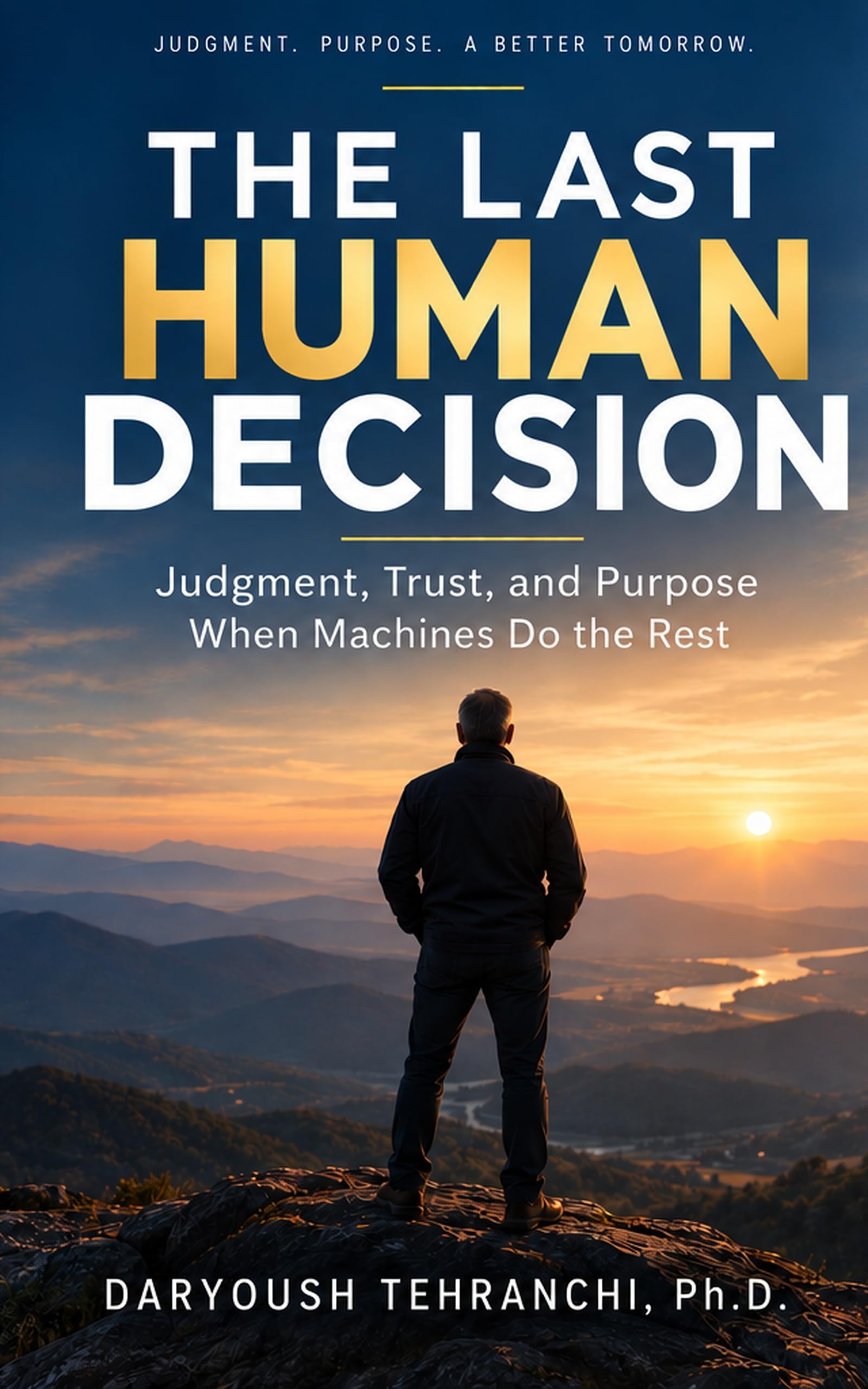
They’re companion books in The Human Warrant Series, asking the same question at two levels. Nobody Delegated This is the organizational version — structures, authority, accountability. The Last Human Decision is the personal version — judgment, trust, purpose. The series also includes Tested, Not Trusted and Too Good, Too Soon.

The author
Dr. Daryoush Tehranchi is an engineer, architect, educator, and author whose work focuses on complex systems, systems and software architecture, digital engineering, artificial intelligence, technical leadership, and the decisions that remain fundamentally human.
The Human Warrant Series
More from the series.


Connect with Daryoush